
Biometric Control and Tracking in Hazardous Environments
Biometric of a scientist with futuristic graphics. Business vision graphic scanned.
Modern industries, encompassing everything from extensive research laboratories to busy manufacturing plants, deal with various challenges when it comes to security and safety. These hazardous environments, by their very nature, demand control over who enters, where they go and how long they stay inside the premises.
Manual methods of visitor management, passwords and PINs are increasingly proving to be obsolete and inconvenient, when one of the most important factors is to ensure the well-being of personnel. Biometric control can help protect dangerous or hazardous environments and aid the staff as they need to maintain everything under control.
Why does one need to use biometric systems in high-risk zones?
Biometric systems in high-risk zones are needed because they can replace traditional manual verification methods and reinforce security. Effective visitor management and employee biometric attendance supervision in these settings revolves around compliance with regulatory bodies and contracts, adherence to safety protocols and the overall operational integrity of the facility.
There are various types of hazards in the workplace—from misuse of equipment or substances to faulty operations. Knowing precisely who is on-site at any given moment, where they are authorized to be, and thus having an accurate record of their whereabouts can help:
- Avoid device malfunctions;
- Mitigate dangerous situations that include chemical substances;
- Provide the staff with a feeling of calm;
- Improve crowd control;
- Manage employee shifts more easily.
As we can see, biometric attendance and visitor management can be useful for several parties: the staff, the attendees and the facilities as well.
Applications in specific hazardous environments
Laboratories
Laboratories often house proprietary research, dangerous chemicals, highly sensitive equipment, and valuable biological samples. An unauthorized individual gaining access to a restricted lab area could lead to the theft of intellectual property, contamination of experiments or even dangerous chemical exposures.
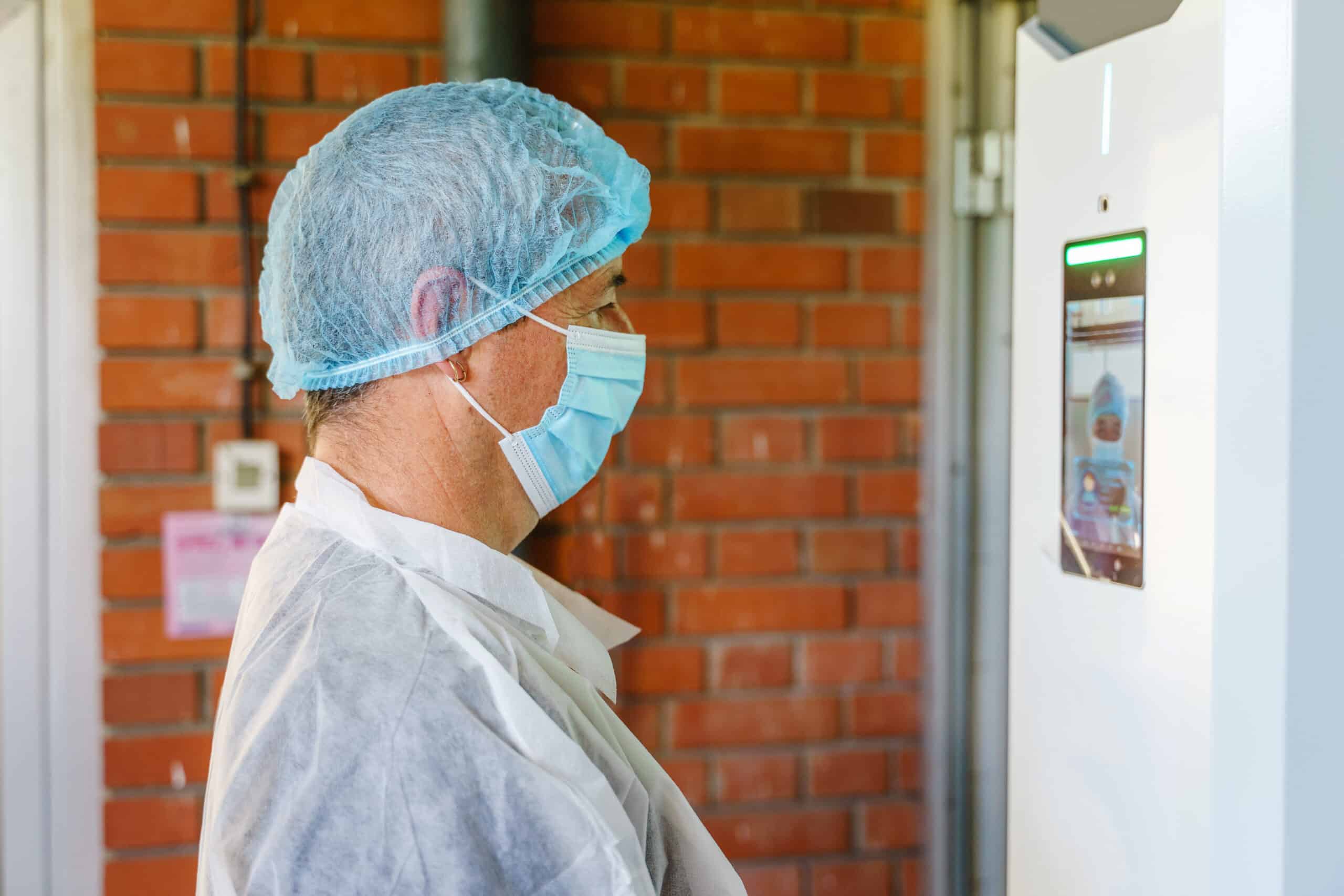
For instance, in a pharmaceutical research lab, a visitor, perhaps a vendor servicing a piece of equipment, needs access to a specific cleanroom. With a biometric system, their pre-registered fingerprint or facial scan grants them access only to that designated area, for a pre-defined period, which should help avoid chemical hazards.
Any attempt to access an unauthorized zone would trigger an immediate alert. Such advanced control is simply impossible with traditional methods, which would only provide a bare-minimum level of security.
Factories
Manufacturing plants, with their heavy machinery, complex production lines and sometimes vulnerable materials, pose risks of industrial accidents, equipment damage, as well as production disruptions.
A visitor wandering into a restricted zone without proper safety induction or personal protective equipment/gear could be seriously injured or cause an accident that impacts production. Biometric systems in factories ensure that contractors and visitors only access areas relevant to their work and only after verifying they have met all necessary safety requirements.
This prevents unauthorized individuals from interfering with machinery, accessing sensitive production data or entering areas with high-risk processes, where only trained professionals can work.
What are the other dangerous environments that also benefit from biometric access control?
Beyond labs and factories, numerous other environments demand high-class biometric access control due to their dangerous nature and the risks they can pose.
Power plants, for example, contain high-voltage equipment and critical infrastructure, where unauthorized access could lead to widespread outages or catastrophic failures.
Data centers hold great amounts of information and intricate IT infrastructure, making them liable for security breaches. The hardware is expensive and often cannot be replaced in a short period. With the help of biometric technologies, security personnel can track who, when and for how long someone was in a specific server room and whether that person is the company’s employee.
Every entry is marked in an extensive audit trail, not only for archival storage, but also to assess risks and quickly verify who could have tampered the local systems or equipment.
Mines are characterized by their dark underground conditions, where employee safety is the number one priority. For example, fingerprint recognition systems can be used to clock employees in for their shifts and to control access to particularly dangerous deep areas.
Biometric markers ensure that only properly trained staff members can enter these specific zones. Additionally, biometric devices and systems can register employees on special lifts that transport them underground. This means that the implementation of biometrics helps to organize shifts, count the employees in case of an emergency and helps to follow strict security regulations.
Even certain construction sites, especially those with hazardous materials or complex lifting operations, require strict control over who enters and where they go. Learn more about how biometric systems can improve the workflow of construction sites.
In such environments, biometric systems provide peace of mind to both administration and employees by ensuring a secure environment.
What are the drawbacks of traditional approaches?
When we talk about the drawbacks of traditional approaches, we need to emphasize that manual sign-in sheets are easily falsified, they can also be lost or misplaced. Badge systems can be susceptible to sharing or even theft.
Relying solely on human oversight for tracking visitor movements in complex, enormous facilities is prone to error. In an emergency, for instance, a lack of accurate information about who is on-site can make evacuation harder.
What are the benefits of biometrics for dangerous environments?
The benefits of biometrics extend far beyond just granting or denying access. Integrated biometric systems can provide real-time tracking of person movements within a hazardous facility. This means knowing precisely when a visitor or an employee entered a specific zone, how long they remained there and when they exited. This information is important for:
- Safety compliance: Ensuring everyone adheres to designated safe zones and don’t wander into high-risk areas.
- Incident investigation: Providing data for post-incident analysis, helping to reconstruct events and identify potential breaches to mitigate such instances in the future.
- Emergency response: Quickly identifying all personnel, including visitors, present in a facility during an emergency, facilitating efficient warning and evacuation.
A comprehensive solution like NCheck can provide an all-in-one framework for managing visitor access and tracking in these demanding environments.
To give an example, with the help of a face scanner, entry to authorized individuals can be granted in a contactless way and without a hassle.
Its capabilities for secure identity verification and detailed logging make it an ideal choice for construction sites and labs, as the system is able to recognize people wearing safety helmets and medical masks.
Final notes
The implementation of biometric technology offers a sophisticated solution to the security challenges of hazardous environments, providing a level of control and accuracy that traditional methods simply can’t match.
Biometric solutions not only prevent unauthorized access to sensitive areas but also provide an efficient way to track personnel movements, ensuring a safer and more secure environment for everyone on the premises. Choosing a certified biometric technology provider like NCheck will help you install a reliable system that is tailored to the specific needs of your business.